
AI Automation Academy
Free download
I built a ChatGPT agent to 100x my customer replies
Both n8n workflows from the video, plus the customer service playbook they read from. Every new email shows up with a reply already written.

Marty VaughnAI Agents on YouTube
Just watched the customer email build? This is everything that was on screen. The upload workflow, the agent workflow, and the Andromedus Rockets playbook that both of them are built around, exactly as they were at the end of the video, with every credential stripped out so you connect your own.
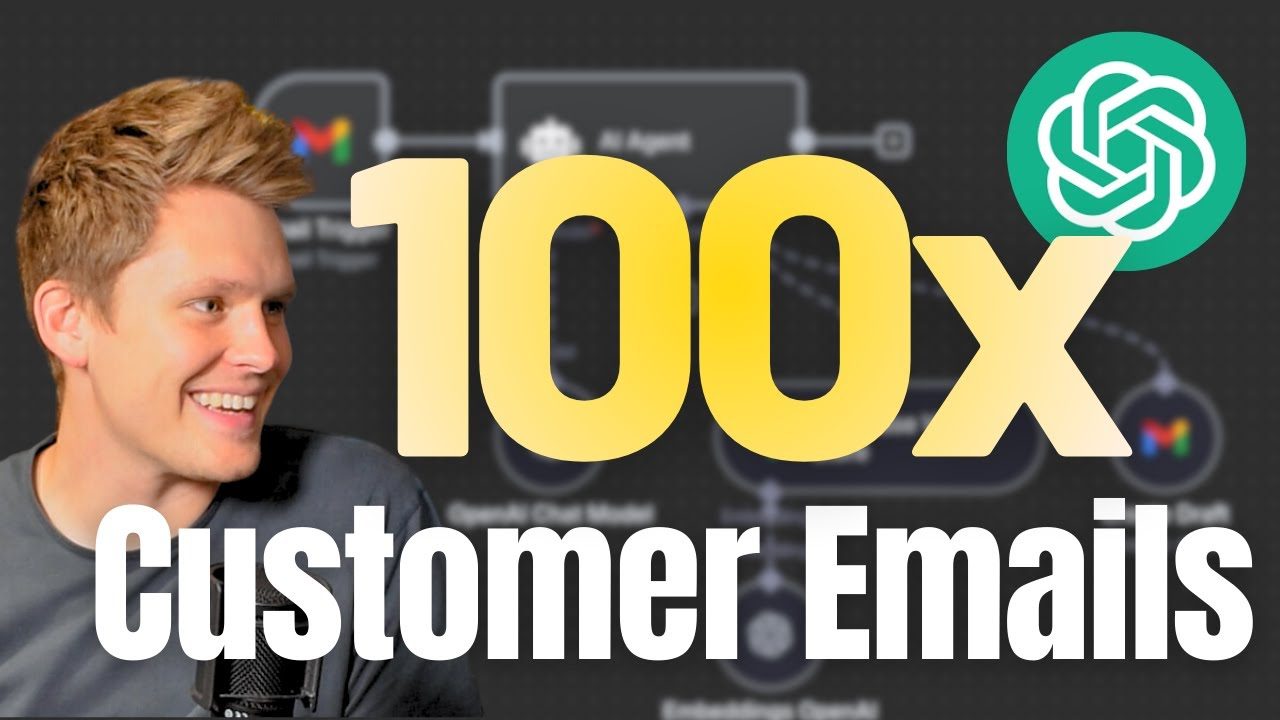
What it actually does
It watches one label in your Gmail. When a customer email lands there, it reads the subject and the body, goes and finds the parts of your customer service playbook that are closest to what the person asked, writes a reply in that voice, and saves it as a draft on the same thread. Then it marks the email as read so it never writes a second draft for the same message.
Nothing sends. You open your inbox, read the draft that is already sitting there, and press send if it is right. That is the whole point of the shape: a reply that takes six minutes to write takes six seconds to check.
Why it reads a playbook instead of being told what to say
You could paste your whole customer service document into the prompt every single time. It works, and it is expensive and slow, because the model has to read all of it to answer one question about shipping.
So the playbook goes into a vector store first. That is the first workflow in the kit: it chops the document into chunks and files each one by what it is about. Then when a customer asks something, the agent pulls only the handful of chunks that are actually related and answers from those. Cheaper, faster, and more accurate, because the model is looking at the four paragraphs that matter instead of skimming twelve pages.
Customer:
      Hi, I'm looking to buy a blue rocket.
      Is that an option?

Draft, waiting in the inbox:
      Thank you for reaching out about our rockets.

      However, all of our rockets come in one color,
      black. This isn't a limitation. This is a legacy.

      Best regards,
Andromedus Customer ServiceWhat is in the kit
- The upload workflow. Pulls your playbook out of Google Drive, chops it into chunks, and loads it into a Supabase vector store. You run it once by hand and then forget it.
- The agent workflow. The Gmail trigger, the mark-as-read step, the agent, the model, the vector store as a tool, and the Gmail draft tool, wired the way they were at the end of the video and carrying the system message that was written on camera.
- The playbook, as a PDF. Andromedus Rockets, a company that does not exist. Use it to get the whole thing working end to end before you point it at anything real.
- The same playbook, as a Word document. This is the one you actually rewrite. Replace the voice, the templates, and the FAQ answers with your own, save it as a PDF, and upload that instead.
What you can do with it once it runs
- Answer the same fifteen questions once. The FAQ section of the playbook is where most of the value is. Write an answer once, and every version of that question gets it back, phrased for the person who asked.
- Keep one voice across everybody who answers email. The playbook is the voice. It does not matter who is pressing send.
- Point it at a second label. Refunds, or shipping, or a different brand entirely, each with its own playbook in its own vector store.
- Change how it writes by editing a document, not a workflow. Rewrite the playbook, re-run the upload, and every reply from then on is different. You never touch the agent.
What you need
An n8n account, which has a free trial and is where both workflows live. A Supabase account, which is free and is where the playbook gets stored. A Google account, for Drive and Gmail. And an OpenAI API key, which is the only part that costs anything: it is billed by usage, and $5 of credit goes a very long way at the model this uses.
Two of the steps are slower than the rest. Connecting Google means making a project in the Google Cloud console, and there is a five minute video that walks through it. Setting up the vector store means pasting a block of SQL that Supabase hands you into Supabase itself, which sounds worse than it is: you copy it from one page and paste it into another, with one small edit that the next page tells you about.
What it costs to run
Cents. The model is the cheap one on purpose, and the vector store is the reason it can be: the agent only ever reads four chunks of your playbook per email instead of the whole thing. Add $5 to your OpenAI balance and you will be testing this for months. Supabase's free tier covers a document like this with room to spare, and n8n's own plan starts free.